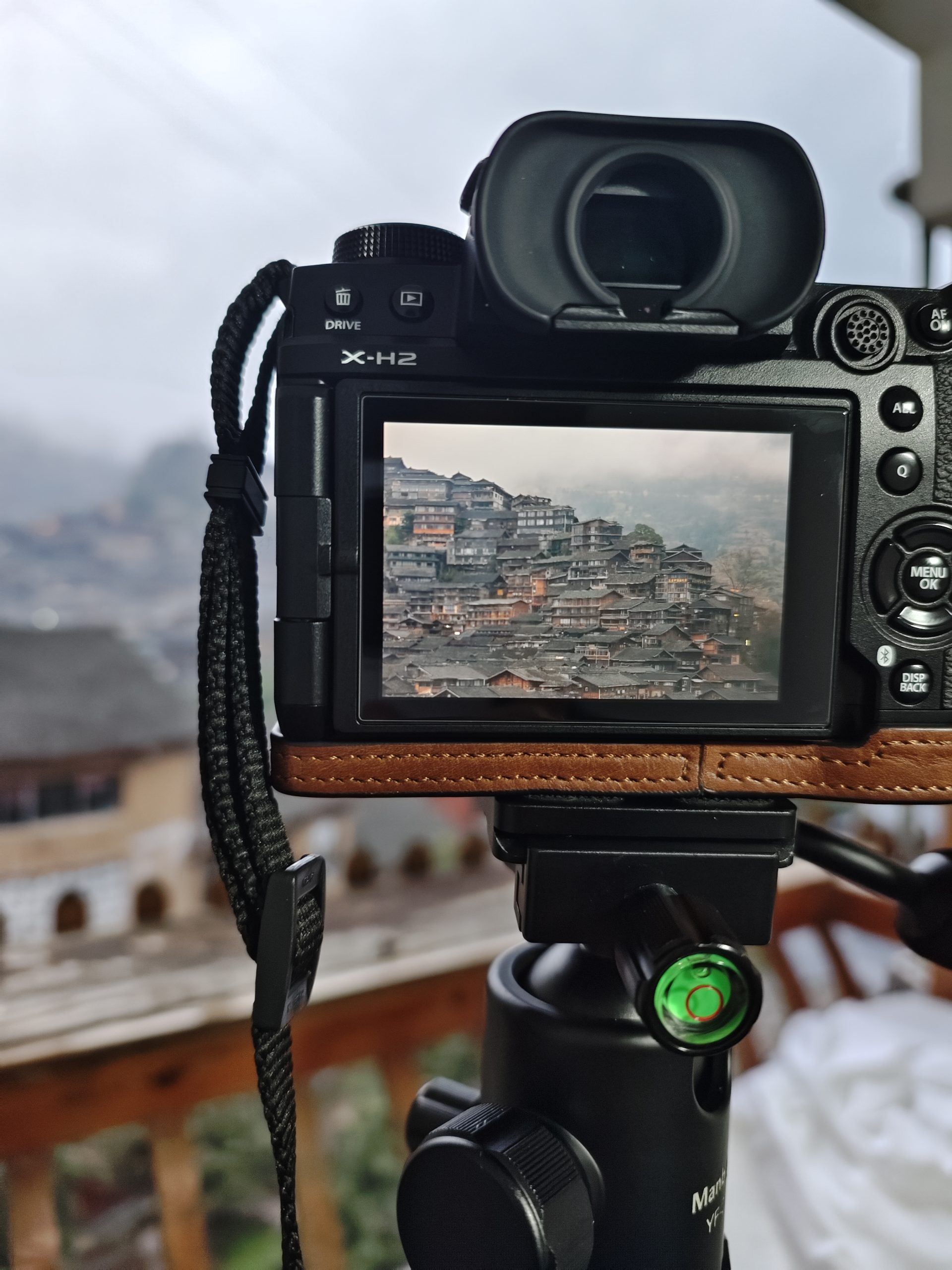




Qiandongnan in the Lens: The Lights of Qianhu Miao Village and the Emerald Time of Xiaoqikong
When I arrived at the West River Thousand Households Miao Village, it was just past six in the morning, and a thin mist was drifting over the valleys. I carried my camera straight to the terraced fields in Dongyin Village. Here, there were no crowds at observation decks, only morning fog wrapping around the staggered stilted houses, smoke slowly rising from the wooden eaves, and the light being as soft as a thin veil. At the moment I pressed the shutter, the surfaces of the terraces reflected faint light, the wooden textures of the stilted buildings became even clearer in the side light, and even the figures of Miao elders working early on the field ridges became the liveliest accents in the frame. Later I learned that the stilted houses in the Miao villages are built entirely with mortise and tenon joints, without a single nail or bolt, yet can stand in the mountains for centuries. This is the survival wisdom of the Miao ancestors in harmony with nature, and also the simplest form of architectural beauty captured by the lens.
![图片[1]-In the Lens: The Fireworks of Qianhu Miao Village and the Emerald Moments of Xiaoqikong in Southeastern Guizhou-YiMeng](https://www.zhangpengchao.com/wp-content/uploads/2025/11/ZPC09636-1024x683.jpg)
During the day, the Miao village gradually became lively. I gave up the popular tourist spots and wandered into the old alleys of Youdong Village. The stone-paved roads had been worn smooth by the years, and at the doors of the wooden houses on both sides, a few Miao women were sitting together, embroidering. Their clothes were boldly colored yet harmonious, with floral, bird, fish, and insect patterns stitched in multicolored threads on deep blue homespun fabric. The silver ornaments on their heads glittered faintly in the sunlight. I quietly approached and asked if I could take photos; they nodded with a smile and enthusiastically showed me their embroidery—turns out this is the Miao ‘Da Zi Embroidery,’ each stitch hiding a blessing. Among the young women’s dowries, there is always at least one piece of hand-embroidered formal attire. I crouched nearby, using a wide aperture to capture the liveliness of their fingertips, the contours of their silver jewelry, the intricate details of their embroidery, and the simple, genuine smiles on their faces—all becoming some of the most precious material for cultural photography.
At dusk, I arrived at a lesser-known spot between the No. 5 and No. 6 Wind and Rain Bridges. From here, one can capture a perfect frame of the sunset with the Miao village. The wooden structure of the bridge naturally forms a frame, with gently flowing water in the foreground and stilted houses bathed in the golden sunset in the background. As I was adjusting my settings, a crisp sound of a bronze drum reached my ears. Following the sound, I saw the Yao people in the village preparing for a folk event. A local companion told me that the bronze drum is a treasured asset of the Yao, regarded as a divine gift, only played during important festivals. The relief patterns on the drum body record the Yao’s migration history and agricultural culture. I quickly captured the moment the drum was struck. As the drum sounded, the evening light fell on the drummer’s face, and amidst the interplay of light and shadow, it felt as if one could touch the spiritual belief of this ethnic group.
![图片[2]-In the Lens: The Fireworks of Qianhu Miao Village and the Emerald Moments of Xiaoqikong in Southeastern Guizhou-YiMeng](https://www.zhangpengchao.com/wp-content/uploads/2025/12/ZPC09641-683x1024.jpg)
Leaving the Qianhu Miao Village, I drove to Xiaoqikong in Libo. The karst landscapes here are entirely different from the cultural atmosphere of the Miao village, yet they are equally captivating for photography enthusiasts. The Xiaoqikong Bridge, built in the 15th year of Emperor Dao Guang’s reign in the Qing Dynasty, has a body constructed of cobbled stone, covered with wisteria and ferns. Beneath it lies the mesmerizingly green Hanbi Pond, like a piece of emerald embedded in the mountains. I deliberately arrived around five in the afternoon, when the crowd gradually thins and the sound of water drowns out human voices. Mist drifts over the water, making the scene naturally ‘cool and serene’ without the need for filters. On a small platform at the end of the bridge, I found the perfect angle, framing the ancient bridge, the emerald water, and the old trees on both banks. Sunlight filtered through the leaves, scattering shimmering patches across the water, creating a sharp contrast with the tranquility of the bridge. The moment I pressed the shutter, even I was stunned by this ‘super bonsai’-like beauty.
On the last evening before heading back, I returned once more to the high point of Qianhu Miao Village. As night fell, thousands of lights illuminated the valley, resembling stars falling to earth. Using long-exposure photography, I captured this dazzling night scene. The silhouettes of the stilted wooden houses became even clearer under the glow of the lights, while the occasional distant songs of the Miao people intertwined with the clicking of the shutter. On this trip, I gained not only a memory card full of photos but also a deep understanding of Miao and Yao traditional culture—they are not museum exhibits but live vibrantly in every stilted house, every piece of handicraft, and every festival ritual.
Going through the photos, each one brings back vivid memories: the Miao village shrouded in morning mist, embroidery at my fingertips, the ancient bridge amidst emerald waters, the totem on a bronze drum. These moments frozen in light and shadow are not just a visual delight but a cultural encounter. If you love photography and long to experience the fusion of humanity and nature, a trip to Guizhou is well worth it. Every inch of this land holds stories waiting to be captured by your lens.
![图片[3]-In the Lens: The Fireworks of Qianhu Miao Village and the Emerald Moments of Xiaoqikong in Southeastern Guizhou-YiMeng](https://www.zhangpengchao.com/wp-content/uploads/2025/12/ZPC09965-1024x683.jpg)
![图片[4]-In the Lens: The Fireworks of Qianhu Miao Village and the Emerald Moments of Xiaoqikong in Southeastern Guizhou-YiMeng](https://www.zhangpengchao.com/wp-content/uploads/2025/12/ZPC09621-1024x230.jpg)
![图片[5]-In the Lens: The Fireworks of Qianhu Miao Village and the Emerald Moments of Xiaoqikong in Southeastern Guizhou-YiMeng](https://www.zhangpengchao.com/wp-content/uploads/2025/12/ZPC09622-1024x230.jpg)









暂无评论内容