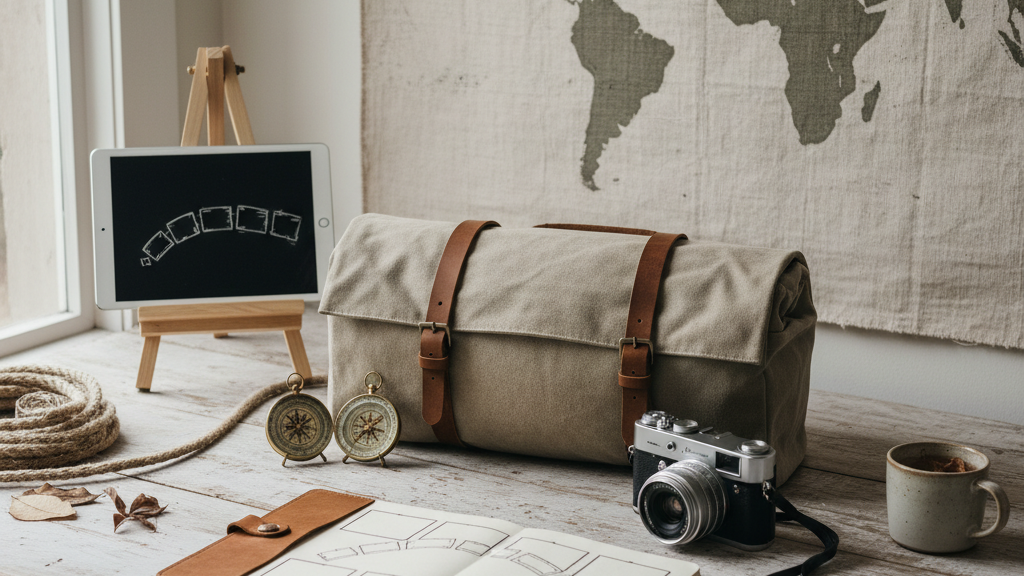




Minimalist Editing for Travel Stories: Crafting Publish-Ready Visuals with a Single Bag
This guide shows how to edit and sequence travel visuals with a one‑bag, one‑lens mindset so your features are publish-ready: a tight narrative arc, clean shot lists, brand-consistent captions, and a repeatable delivery workflow that editors can’t ignore. ⏱️ 5-min read
Minimalist Editing Philosophy for Travel Stories
Minimalist editing starts before you press the shutter: choose economy over excess. A single-bag approach forces decisions that benefit story clarity — you won’t drown editors in choices. Prioritize images that advance an arc, reveal place or character, and fit the buyer’s tone. Every kept frame should have purpose: setup, transition, or payoff.
That discipline makes selections faster, galleries cleaner, and pitches sharper — and it’s attractive to editors who want publishable sequences, not five alternate shots of the same moment.
From Idea to Narrative Arc: Building a Travel Photo Essay
Begin with a single core idea — a ritual, a trade, a change in place or season — then map it to a compact 6–8 shot arc. Think in acts:
- Setup (1–2): establish place & context
- Progression (3–5): introduce people, detail, and change
- Payoff (1–2): emotional or visual resolution
Sketch a quick storyboard on arrival: label frames with where, who, when, and why. Emphasize place, people, and visible change across locations — the combination that turns good images into a cohesive essay.
Crafting Editor-Ready Shot Lists that Sell Travel Features
A tight shot list sells faster than a sprawling folder. Organize by scene and include the essential data editors need to assess and run a feature.
Shot-list structure (one sheet per story):
- Scene ID — short descriptor (e.g., “Harbor morning”)
- Shot type — wide/mid/portrait/detail
- Time & light — golden hour/midday/night
- Mood & story role — setup/progression/payoff
- Caption seed — 15–25 word caption suggestion
- Color notes & deliverable specs — profile, size, alt crops
Pair the shot list with a one‑page sell summary for editors: logline (one sentence), 50–70 word blurb, required images, suggested lead image, and technical deliverables (formats, captions, credits). That short, front-facing document speeds decisions.
Composition, Color, and Context with a Single Lens
Working with one lens (whether a 35mm prime for intimacy or a 24–70mm for flexibility) forces stronger composition. Master a handful of techniques you can rely on across subjects:
- Leading lines and frames to anchor landscapes and streets
- Negative space for portraits and quiet moments
- Consistent color accents (a scarf, market tarp, painted door) to tie shots together
Plan a mix of portraits, mid-distance environmental frames, and close details that together read as place. With one lens, change your position rather than your gear: step closer for detail, back up for context, and use the same color preset to keep the palette unified.
Destination Research and Brand-Voice Consistency
Before you edit, do a short destination brief: audience expectations, key terms and phrases, sensitive topics, and three reference images that capture the brand’s tone. This keeps your captions and framing aligned with the buyer.
Build a simple brand-voice/style sheet for each frequent client or buyer that includes:
- Tone: punchy, lyrical, clinical
- Caption length target (e.g., 20–30 words for web; 40–60 for print)
- Preferred tense and attribution rules
- Terminology to use or avoid (local names, transliteration, honorifics)
Use these notes while writing captions and the one-page sell — consistent voice reduces rounds of edits and speeds publication.
One-Bag Editing: Minimalist Workflow for Travel Photographers
Keep editing in a single workspace — a lightweight laptop or tablet with a fast SSD and a reliable catalog. A repeatable flow saves time and preserves quality:
- Cull fast: flag 2–3× more than you plan to deliver, then reduce again.
- Adjust: global fixes first (exposure, white balance), then local polish.
- Keyword & metadata: add location, subjects, and usage rights immediately.
- Export & deliver: use presets for the most common export targets (web, print, social).
Use non‑destructive edits and metadata templates so every change is traceable. Save metadata and versions in XMP or through your catalog to keep edits reproducible when an editor requests alternate crops or higher resolution files.
Travel Feature Sequencing and Storyboarding
Sequence images to mirror the narrative arc: start with a strong opener to hook the reader, move through revealing moments, and end with a quieter image that provides closure. A typical order places the most compelling image within the first three frames and concludes with a reflective or contextual shot.
Use shot cards (one line per image: file name, caption seed, crop) to communicate intent to editors. They act as a bridge between your vision and the publication’s layout team and often speed approvals.
Templates, Tools, and Real-World Examples
Keep a small toolkit of templates and presets that travel with you:
- Shot-list sheet (scene | shot type | time | mood | caption seed)
- Caption template (headline | location | subject | action | date | credit)
- Brand-voice one-pager (tone, length, do/don’t list)
- Export presets (sRGB 2048px for web, 300dpi TIFF for print)
Mini case study — Coastal fishing village (6-shot arc):
- 1: Wide harbor at dawn — establishes place (lead image)
- 2: Fisher returning with nets — introduces character
- 3: Market scene — progression; people and trade
- 4: Close detail of hands mending a net — texture and craft
- 5: Local ritual or meal — payoff; culture & continuity
- 6: Sunset silhouette on the pier — quiet finish
For each frame include a caption seed, color note (warm highlights, cool shadows), and deliverable size. Present this with your one‑page sell and editors immediately see the story and technical readiness.
Minimalist editing with a single bag is a discipline that enhances clarity, speeds delivery, and makes your travel features easier to commission and run. Keep your arc tight, your lists clean, and your voice consistent — the rest follows.
![图片[1]-Minimalist Editing for Travel Stories: Crafting Publish-Ready Visuals with a Single Bag-YiMeng](https://www.zhangpengchao.com/wp-content/uploads/2025/11/DSF8546-scaled-e1763013651377-1024x1024.jpg)



暂无评论内容